• Welcome to the Yamaha FZ6 Forums. Member registration disables ads and allows you to post and share. Register Here.

Buzzing prominent on right side

I had planned to get a new CCT a while ago and just received it lately.
I hope it's the 'new and improved' part.

I don't have a garage to keep my bike and the weather has had much rain and blowing wind outside.
I have been keeping my FZ6 and others under a cover for now.
I have many jobs to accomplish on the bike including suspension,etc.,so I will report back when I finally get back out to my parking space where I'm temporarily parking/working on my bikes;it's been 6 years working like this so far.
 

Attachments

  • 20251224_101204.webp
    20251224_101204.webp
    872.6 KB · Views: 1
Last edited:
Good evening and happy holidays to everyone. Happy New Year too!

I've already synchronized the throttle bodies with the Carbtune Pro 4 vacuum gauge, and I have to say it was a success! After spending about half an hour getting cylinders 2, 3, and 4 to the same level as cylinder 1 (giving them short bursts of acceleration until they stabilized), because it's incredibly difficult to adjust them. It's not a matter of millimeters or microns; you'd say you need to adjust by a smaller amount. If you go too far, the Carbtune's pivot rises too much, and conversely, it lowers too much.

Anyway, I went for a drive, because revving the engine from 6000 to 7500 rpm while stationary wasn't enough. It's true that when stationary it behaves pretty much the same as when moving, since the vibrations come from inside the engine (the cylinders).

So, once I went out for a ride and accelerated in second gear, going through 5500, 6000, 6500, 7500 rpm...

The change was quite astonishing, to the point that I'd say the bike feels different. It's as if it's been fine-tuned, and we're talking about an inline four-cylinder engine mounted to the frame by what are, shall we say, less-than-ideal rubber mounts.

I had to test it several times, as much as I could manage since the city's ring road is right next to my house, and I repeat, it was a pretty drastic change. I'd say the bad vibrations have disappeared by 95% to 97%. There are still vibrations, but they seem normal, nothing like they were before.

The mirrors now have a slight "numbness," so to speak, but it's nothing like before, when at the aforementioned RPMs the image would become completely blurry, making it impossible to see clearly.

I haven't touched the counterweights at all. I preferred to synchronize the throttle bodies first with the vacuum gauge, and since the result was positive and favorable, I'm not going to touch them.

So, nothing more to add. After a few years, it seems the problem is solved. If this helps anyone, well, here it is. I'll keep the vacuum gauge in case I need to repeat the operation in X kilometers. I hope I don't have to, and that the bike stays like this for as long as I own it.

After the holidays, I'll take it out on the road for a longer test and I'll share the experience here.

Best regards and happy holidays!

 
Good evening and happy holidays to everyone. Happy New Year too!

I've already synchronized the throttle bodies with the Carbtune Pro 4 vacuum gauge, and I have to say it was a success! After spending about half an hour getting cylinders 2, 3, and 4 to the same level as cylinder 1 (giving them short bursts of acceleration until they stabilized), because it's incredibly difficult to adjust them. It's not a matter of millimeters or microns; you'd say you need to adjust by a smaller amount. If you go too far, the Carbtune's pivot rises too much, and conversely, it lowers too much.

Anyway, I went for a drive, because revving the engine from 6000 to 7500 rpm while stationary wasn't enough. It's true that when stationary it behaves pretty much the same as when moving, since the vibrations come from inside the engine (the cylinders).

So, once I went out for a ride and accelerated in second gear, going through 5500, 6000, 6500, 7500 rpm...

The change was quite astonishing, to the point that I'd say the bike feels different. It's as if it's been fine-tuned, and we're talking about an inline four-cylinder engine mounted to the frame by what are, shall we say, less-than-ideal rubber mounts.

I had to test it several times, as much as I could manage since the city's ring road is right next to my house, and I repeat, it was a pretty drastic change. I'd say the bad vibrations have disappeared by 95% to 97%. There are still vibrations, but they seem normal, nothing like they were before.

The mirrors now have a slight "numbness," so to speak, but it's nothing like before, when at the aforementioned RPMs the image would become completely blurry, making it impossible to see clearly.

I haven't touched the counterweights at all. I preferred to synchronize the throttle bodies first with the vacuum gauge, and since the result was positive and favorable, I'm not going to touch them.

So, nothing more to add. After a few years, it seems the problem is solved. If this helps anyone, well, here it is. I'll keep the vacuum gauge in case I need to repeat the operation in X kilometers. I hope I don't have to, and that the bike stays like this for as long as I own it.

After the holidays, I'll take it out on the road for a longer test and I'll share the experience here.

Best regards and happy holidays!
Excellent results ;)
 
Glad you got it running as it should.

How close, in MM. were you able to get it (just curious)?

The factory allows for up to 10MM
Good evening and happy holidays!

I'm not exactly sure what you mean by the 10mm measurement. If it's about cutting the spark plug wires, I already tried that and it didn't work. I also replaced the coils and wires with ones from a salvage yard, and it was the same.

The solution came today with the adjustment of the throttle bodies using a vacuum gauge, and the result was more than satisfactory.

Best regards and Merry Christmas!
 
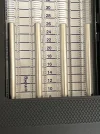
The 10mm measurement refers to the mmHg spec for vacuum. On the Carbtune Pro it is called out in cm rather than mm. So each number on the carbtune represents a 20mm step, and the spec allows for 10mm difference between cylinders.
In this picture, 26 represents 260mm. So if the cylinders all ranged from between 26 and 27 on the carbtune, it would be considered 'in spec.'

img_1577.webp
 
The 10mm measurement refers to the mmHg spec for vacuum. On the Carbtune Pro it is called out in cm rather than mm. So each number on the carbtune represents a 20mm step, and the spec allows for 10mm difference between cylinders.
In this picture, 26 represents 260mm. So if the cylinders all ranged from between 26 and 27 on the carbtune, it would be considered 'in spec.'

View attachment 93798
Oh, I thought you were referring to something else.

In this case, the adjustment I made to cylinders 2, 3, and 4 was no more than 2-3 mm up/down. The one that was most out of balance was cylinder number 4; it was the one that was higher, or above the reference measurement of number 1 (because, as I've read, number 1 shouldn't be touched). I should have taken photos, but I forgot, as I was more focused on doing everything correctly. I was outside, and the sunlight was fading. If the weather is nice another day, I'll reconnect it and take photos of the process, since it's quite simple. I've also marked the hoses.

If anyone needs help, I'll be around. Cheers.
 
Yep, sounds like you got em darn near perfect!

Also, sometimes, if the others won't match up with #1, you can adjust #1 out to 1 full turn, vs the standard 3/4(usually)
turn out..

This allows the others to adjust.

Just an FYI for others should they encounter this issue..

.
 
Back
Top