• Welcome to the Yamaha FZ6 Forums. Member registration disables ads and allows you to post and share. Register Here.

Historically Important Motorcycles

lonesoldier84

SuperFlanker Moderator
Moderator
Premium Member
Joined
Apr 19, 2008
Messages
4,461
Reaction score
96
Points
48
Location
Surrey, UK
Visit site
I have found over the past few weeks that the history of motorcycles themselves is extremely interesting. I'd love to hear which bikes some of you guys think were important motorcycles up until today that made bikes what they are today and what they will be in the future (they don't need to be from 20-40 years ago to be important historically).

I think the reason I found it especially interesting is first of all I'm a history buff anyway. Secondly I enjoy all things mechanical. But the big thing is my introduction to motorcycles in terms of riding came on Royal Enfield Bullets on vacations to India every few years. It is essentiallt a 1940-1950's era machine that has not changed in design at all really since then. So for me what was a "modern" bike was actually a relic. But it was still functional, beautiful, and fun. So to think how the bikes of yesteryear (all of them equally fun, functional, and beautiful to their respective owners) adapted over the years to become the vast array of bikes today is quite interesting. Evolution and natural selection bred them and did so wonderfully!! And it's still ongoing...

Here are some I find very interesting:

(btw when you post pics would be nice but not a must-have if you dont have any)


Honda CB750
Honda-CB750-4.jpg

1969-honda-cb750-1.jpg


This bike was an ultra-sport for its time era. Extremely efficient, yet ridiculously powerful. Honda's CB450 force had been felt around the world and competitors were scrambling to close the power/efficiency gap. Then while the british were fumbling with unreliable triples to close the HP gap and the americans were grappling with reliability and ease of use issues....Honda blew the world up with this bike, the CB750. Essentially the equivalent of a car company today making a car with the performance of a supercar, but selling it for the price of a hatchback. Truly revolutionary. I love it when common everyday things are epic, truly epic. for example my favorite battles historically were those fought by poorly armed infantry overtaking professional armies. so for this magnificent piece of machinery to be such a powerful and epic piece...and to be sitting in the garages of the everyday man for the first time in the history of motorcycles....it is exceptional to say the least...

If it weren't for this bike we'd be riding much weaker bikes today.

[ame="http://www.youtube.com/watch?v=yeMgEuf30G4"]YouTube - Greatest Ever Motorcycles: # 3 - Honda CB 750 (K0)[/ame]

(more bikes coming from me, but feel free to post your own)
 
Last edited:
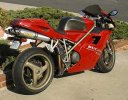
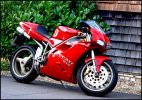
Ducati 916

This one is just a personal favorite of mine, as it is probably 95% of motorcyclists. But not to mention this would be an injustice. And primarily I love it just for how beautiful it is. I don't think there is a bike made which ellicits as fond a feeling as this bike does when you look at it. The fact that it won countless superbike races in the years after its release is an added plus. And the impact it had on moto-design couldn't be denied by even the most stubborn of people. One-sided swingarm....under-tail exhaust....and just overall sex-appeal is too brilliant for words. It is beautiful enough to inspire poetry and music as would any beautiful woman. And like a beautiful woman, the 916 is precious....oh so precious.

Ducati916.jpg

916_bip.jpg
ducati%20916_ekam.jpg
800px-Ducati_916_Senna.jpg

[ame="http://www.youtube.com/watch?v=i6K2CUdqURg&feature=related"]YouTube - Greatest Ever Motorcycles: # 2 - Ducati 916[/ame]
 
I think that there are at least two significant motorcycles that shaped the vista for our modern crop of sportbikes..

-1973 Kawasaki Z1. The original "Superbike". Although the Honda CB750 came out 4 years earlier it was a tame, everymans vehicle compared to the raw performance of the Z1.
Kawasaki_Z1B_11.jpg


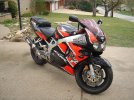
- Honda Hurricane CBR600F. This introduced the concept of an all around sportbike to the masses. It looked sleek, it had true handling virtues, it was reliable and it was fast. This was a true street-legal track bike. It started the trend.
Honda%20Hurricane%20600.jpg


As a side note, here is an image of myself with my 1978 Kawasaki Z1R from approx. 1980:
 
Honda Hurricane CBR600F. This introduced the concept of an all around sportbike to the masses. It looked sleek, it had true handling virtues, it was reliable and it was fast. This was a true street-legal track bike. It started the trend.

here's some snaps of some '87s and '88s:

2273588910_b17435cb39.jpg

Hurricane.jpg

2272791569_f4c7ce5fef.jpg
 
Well, I still think that Dr Hunter S. Thompson had it right. The Vincent Black Shadow. Possibly the most EVIL bike of all time. They were getting '90s type speed with '50s type tech. R.I.P. Gonzo! GRUMPY
 
Well, I still think that Dr Hunter S. Thompson had it right. The Vincent Black Shadow. Possibly the most EVIL bike of all time. They were getting '90s type speed with '50s type tech. R.I.P. Gonzo! GRUMPY

Excellent quote. :thumbup:

rollie_free.jpg

ok... it's a Black Lightning, but sure surely it's just as evil as the Shadow.
 
Call me biased because i own one, but the Ducati 500 Pantah was the first of the belt-driven camshaft Ducati motors. Just about every engine Ducati has put in a bike since has evolved from the basic layout of this engine

View attachment 5724

a quote from our frriends at Wikipedia

"The Pantah 500 is where the current line of V twins began. Developed from the last of the GP500 racers of 1973, the Pantah and its successors have shown that, contrary to the previously accepted wisdom, a twin can race against the fours and win."

...so this must give it some qualification as "Historically important". Even if it isnt the most attractive bike Ducati has made.

And yes it is a well known fact that the 916 was a landmark bike, still looks as fresh today, as it did the day they came out.
 
Laverda Jota
The Laverda Jota was, for a brief but golden spell in the late 70s, the most powerful and fastest production motorcycle that money could buy. The Big Japanese fours killed it in performance and reliability, bringing the era to an end by 1980.

Benelli 900Sei and Honda CBX

The Benelli 750/900Sei was a monster six cyliner much in the same vane as the Honda CBX. Both of these had there important place on time too.
 
Laverda Jota
The Laverda Jota was, for a brief but golden spell in the late 70s, the most powerful and fastest production motorcycle that money could buy. The Big Japanese fours killed it in performance and reliability, bringing the era to an end by 1980.

Benelli 900Sei and Honda CBX

The Benelli 750/900Sei was a monster six cyliner much in the same vane as the Honda CBX. Both of these had there important place on time too.

that engine has sooo many header pipes to clean...:eek:
 
The 1970 to 1972 Yamaha R5. It ain't much to look at the this bike was the beginning of Yamaha's two stroke domiance for the next 20 years. I was based on the Yamaha TR roadracers of the day. The R5 lead to the RD350 the next year, then the RD400s, the RD350LCs and finally the RZ350 (power valve models).

First photo is the R5, second third are of the TR3. BTW...the TR3 won Daytona in 1972 which started Yamaha's winning streak for the next 13 years there.
 
The 1970 to 1972 Yamaha R5. It ain't much to look at the this bike was the beginning of Yamaha's two stroke domiance for the next 20 years. I was based on the Yamaha TR roadracers of the day. The R5 lead to the RD350 the next year, then the RD400s, the RD350LCs and finally the RZ350 (power valve models).

First photo is the R5, second third are of the TR3. BTW...the TR3 won Daytona in 1972 which started Yamaha's winning streak for the next 13 years there.

I must agree, the Yammy 2 strokes deserve credit, how many of us cut our teeth on these simple, but fast bikes???...thanks for reminding me of good riding times past...had an RD350 many years ago...went like a shower of s*&%, cost stuff all to run, was the choice of every poverty stricken uni student in their day! :)
 
Well, I still think that Dr Hunter S. Thompson had it right. The Vincent Black Shadow. Possibly the most EVIL bike of all time. They were getting '90s type speed with '50s type tech. R.I.P. Gonzo! GRUMPY

that's a pretty cool bike!!

33170Untitled-10.jpg

07_450.jpg

The Vincent Black Shadow was a hand-built motorcycle produced by Vincent HRD from 1948. The series "C" which was introduced in the early 1950s had a 998 cc 50 degree OHV V-twin engine running a 7.3:1 compression ratio.

...


The first model from Vincent was the Rapide. However due to demand for a more "Sports oriented model", the Black Shadow was introduced. The model became so popular that the production of the Black Shadow exceeded the production numbers of the Rapide. The Black Shadow was a "Stressed Frame" design. The engine, instead of being cradled in a set of frame rails, was suspended from above becoming an integral part of the structure. The Black Shadow as well as the other post Second World War Vincents featured several new technological innovations such as a unique and original alternative to the primitive telescopic front forks of the day, a sprung rear sub-frame, the extensive use of aluminium alloy and a unit construction stressed engine. It weighed in at a relatively light 458 lb[1] (207 kg) which was about the weight of a pre-war 500 cc bike.

The inspiration for the Black Shadow was Royal Air Force pilots flying over the factory, and soldiers serving in the war. The designers created a motorcycle that could be operated and maintained by men who had been injured in combat. The clutch could be operated with just two fingers, and maintenance was made far easier than anything previously available.[citation needed]

The reason for its name "Black" Shadow was due to the entire bike (including the engine) being coated with black paint. The reason for the black paint on the cylinder block is still disputed to this day. Some claim that the black paint was for looks, others claim that it had something to do with heat transfer and dissipation. Whatever the original reason behind the painting of the engine, it was very different from anything else at a time when everything was polished and chromed.

Fewer than 1,700 [2] Vincent Black Shadows were made, all hand-assembled . It is now highly prized by classic motorcycle collectors from around the world, and is valued in excess of $60,000 USD in today's market. In the 1960s Vincents were being sold for $200 to $900 at then prices.

[ame="http://www.youtube.com/watch?v=m2aIvgQYex4"]YouTube - Vincent Black Shadow ride[/ame]
 
Last edited:
As someone who didn't know an inverted fork from a dinner fork until last summer when I got my FZ, may I say this thread is fascinating! Thanks for the quick history lesson, and the great photos! :rockon:

And that Daimler Einspur gave me (sorry) a woodie! :thumbup: :thumbup: :thumbup:
 
some more on the vincent....i want one now :)

V-twin up close:
56808Untitled-4.jpg


analog speedo
77094Untitled-3.jpg


profile shot
88352Untitled-6.jpg


2007 Vincent Black Shadow - First Ride
7/6/2007
By Trevor Franklin
Pictures by Paul Bryant

Our cultural exchange program with our motorcycling buddies overseas at Motorcycle News continues as they give us the scoop on the latest reincarnation of the Vincent Black Shadow.

Pictures don't do this Vincent Black Shadow justice. After first staring at e-mailed pics of it for a long, long time, my conclusion was it looked immaculate; the biz. But now, in a garage in Kent, with its chromed and painted parts just inches from my fingertips, my thoughts start with 'immaculate' and end with 'perfection'. It doesn't matter which bit my eyes fall on, it's 'perfection'. This must be how the 2200 worldwide members of the Vincent HRD Owners Club first got hooked.

From the gloss black finish of the engine cases to the chrome rimmed upright speedometer and all the parts precisely torqued in place elsewhere, there's not a sign of ill-fitting tool abuse or stains from years of grime and use - the usual traits of age and restoration. And there's a very good reason for this: this Vincent is not a restoration. It is new - all new. Every grease nipple, section of frame and cables are under 500 miles old. The smell of a slight fuel weep and marked tires are the only items to show this is a runner. Oh, and there's the '07 registration plate. Awesome.

And now it's my time to start it. Although drilled in the precise technique, I admit I'd forgotten it just after turning one of the two fuel taps on (it had already been run to warm the engine) and debating whether to push the bar-mounted choke levers to fully on. Instead, I take up on the offer of help to start it. One of the three carefully watching members of the Vincent Owners Club (VOC) takes over. It starts so easily that I'm truly humbled by the experience and by a machine around sixty years in design.

The burble and rustle of moving parts aren't smothered by the healthy exhaust note. The bobbing of the bike on tickover accentuates the feel of a living, breathing piece of history under this Vincent ignoramus. Excitement and nervousness roll into one. I haven't felt this way since my first ride on a 500 Grand Prix bike, or Rossi's RC211V. I need a wee.

While the clutch lever is in the 'normal' place, the gearlever and its shaft is in another world. My right boot hovers above the gear lever as I struggle to remember the shift movement: one up and three down. First gear goes home with a shunt of metal somewhere along that gear shaft deep in the engine cases. It didn't need the extra blips of throttle and deliberate clutch to pull away. It might be an old 'un but the mechanicals are all there and in mint condition. The shift to second is as sweet. But the front brake isn't.

There's little tension in the two front brake cables down to the twin 7-inch front brake drums. Cheap Chinese trail bikes might have stronger front brakes, but then they are about half the weight of the Shadow. My left foot has to work the two rear brake drums - an alien concept that results in my foot resting on the brake as I pull from a junction only to stall it. Bugger. Time to put into practice those forgotten preachings of starting a Vincent.

Right peg lifted and kickstart swung out in record time, dab the kickstart until compression is reached, pull the de-compressor lever, dab the kickstarter again until it just goes over compression, let go of the de-compressor and stamp down on the kickstarter like it was a slug on my lettuce patch. It starts so easily.

Along A-roads around Brands Hatch, the Black shadow is as happy as I am. The upright speedo's needle ratchets its way round to 70 mph with the occasional break in its ascent from changing gear. Digital speedos, pah, all electrics and expense with no character whatsoever. Bloody lovely: it's sunny and dry and I'm riding a bike with a bark of an exhaust note that is immediately recognizable as a slow-revving classic's.

The damped Girdraulic forks and cantilever-mounted twin rear springs with separate damper chamber are surprisingly modern in feel. They soak up most of the big dips and bumps but let you know when you hit sunken or raised manholes. The freshly adjusted front brake is working at full strength, or rather as much strength as my fingers can muster. Not so much slow but rather deliberate gear changes (one of the VOC three wise men has said I'll hear rapid cog swaps rather than feel them) keep the V-Twin motor on the boil, but then I make a discovery that makes my smile even wider. The throttle tube has a longer throw than I thought, and the extra twist fully lift the remote carb plungers.

That extra rate of fuel kicks off an even bigger smile. It's not a startling rate of acceleration, but something like an old air-cooled SS900 Ducati lump would give up on a good day. The sharper edged exhaust note bounces off hedgerows and trees and I can hear myself coming and going.

At 80 mph there's a strong feeling through the bars and pegs of more speed to come but mechanical empathy rules today. That upright speedo tops out at 150 mph, which was a sharp way of telling the world in its day the 'Shadow' was the fastest bike in the world. But it's not my bike and the tires aren't exactly sports numbers - they are based as close to the original rubber as possible. It's funny how a vision of a skinny (3.5 x 19in) and square-profiled Avon rear tire can pop up with a series of bends approaching. I'll tell you, we don't know we're born today.

Using the front brake makes the chassis dip while the forks stay the same length. If a a comparison has to be drawn it would have to be Yamaha's over-engineered hub-steered GTS1000. A strange feeling but reassuring one at the same time as the bike feels better connected to the road. A little bit of modern day body shift off the seat should see us through these S-bends.

The Vincent takes it all in stride. Yes, the weight of the bike (227 kg / 500.5 lbs wet) is telling through the bars when flicking left then right, not the age of its design. Only that the rear tire causes the stable handling to get upset - riding off the edge of the tread induces a weave which settles down as quickly as it started.

Spirited riding compounds the belief that the Black Shadow really was the Ducati 1098 of its day, and totally understandable why it was the machine to have way back then in the late '40s - even though its £350 (around $700 U.S.) price was on par with a new house. I can also see why people get hooked on wanting a Vincent in the garage today even though we'd be looking anywhere between £25-30K (and more at auction) for a decent original. As for this bike - a brand new machine, don't forget - there's more to say. Read on.

A NEW VINCENT BLACK SHADOW, HOW COME?

The Vincent-HRD Owners Club is a non-profit-making club dedicated to preserving the heritage of the Vincent marque. Not only does it run a very competent and successful club consisting of archivists, engineers, owners, machine registrar, boffins etc., it also has ties with The VOC Spares Company Ltd. This associate company deals purely in spares for Vincent-HRD machines and, together with the club, an idea was formed to build a complete bike to ensure the quality of its spares and to see whether or not every part was available. It also happened to be the next stage up from when the club successfully built a complete new engine in 2004.

The model of the bike was decided - C-model circa 1949-54 - and the plans from 2005 were put into action in early 2006.

The project wasn't easy. While most of the spares are common replacement parts (not copies but made to original dimensions and spec) to fit on existing chassis, a new machine meant building a new upper frame member (the headstock and main spar that also held the engine oil from which the engine attaches/hangs from) and rear frame member (the subframe). There was also the matter of producing the Girdraulic forks to the original exacting standards - in the end the forks were machined from solid so are stronger than the originals although you couldn't tell them apart. The building problems didn't end there. As the club's information officer Paul Adams says: "Where we didn't have the original factory engineering drawings to make parts, we had to measure exactly original components and present them as new drawings to the engineering companies we used. If these parts were quantity ordered they'd be fairly cheap, but the initial outlay would be huge. In effect the parts we had made are bespoke and that sort of quality costs money."

WHAT'S SO SPECIAL ABOUT VINCENT BLACK SHADOWS?

They were deigned by Brits, built by Brits and ridden by just about everybody, and still are. The fact that it was fast for its day, handled as good as any 1970s Japanese bike and was full of technical goodness says it all. I mean, what other bikes do you know where thumbwheels are used to adjust the chain so easily and T-bar-type QD wheel spindle removal is standard? Everything about the bike is adjustable, that's internal and external, it has left and right sidestands that adapt to be a front wheel lift, and there's a mainstand. Adjustable rear damping and steering damper, too. To top it off there's a removable metal tool tray under the seat. To sum up the Vincent Black shadow: the bollocks.

WHO DO I MAKE THE CHECK PAYABLE TO?

You don't. This machine is unique and, therefore, desirable to the point where big money could be involved. But as it essentially belongs to the Vincent-HRD Owners Club it's only fair that the machine will end up in the hands of a club member. All club members are invited to tender a sealed bid for the bike. The closing date for bids is August 31 this year and the winning bid will be announced at the club's annual dinner and dance Oct. 21, 2007. Even this old hack is contemplating joining the VOC.

The VOC has no intention of producing a limited run of complete machines due to red tape (insurance, liability, type approval. However, there will be 'approved constructors' who will uphold the stringent standards the VOC demands and these will be supplied parts to create a bike to customer requirements.

SPECS

Vincent Black Shadow
Cost (est): £25-35k ($49,900-$69,900 U.S.)
Power (claimed): 55bhp
Torque (claimed): N/A
Dry weight: 206 kg (454 lbs)
Colour: Black
Info: 01322 666 455 Untitled Document

TECHNICAL

Fuel: 16 litres (4.22 gal.)
Rake: N/A
Trail: N/A
Seat height: 826mm (32.5 in.)
Wheelbase: 1435mm (56.5 in.)
Engine: Air-cooled 998cc (84 x 90mm) 4-valve SOHC 4-stroke 50-degree V-Twin. 2 x type 276 Amal carburetors.
4-speed gearbox. Chain final drive.
Chassis: Tubular steel duplex cradle frame.
Suspension:Vincent Girdraulic front forks and cantilever-mounted dual springs with remote oil chamber rear suspension.
Brakes: 2 x 7 in. diameter drum brakes front and rear with single leading shoe.
Tires: Avon - 3.00 x 20 front, 3.50 x 19 rear

15256Untitled-9.jpg

5410Untitled-1.jpg
 
Last edited:
The Royal Enfield Bullet 350/500

Royal Enfield was a british company that produced bikes in britain. They opened a factory in India as well. But the british wing ran into financial hardship and shut down. But the FANATIC fanbase in India ensured the Indian factory would always have a market base to keep it going. And for the past 60 years or so they have prospered in India. The design hasn't changed except for the odd update here and there to keep the machine as reliable as possible, the machine is still produced today as it was back then in terms of styling and layout, and a fair bit of the mechanics.

This is the machine that introduced me to the world of motorcycles. Every 4 years or so my family takes vacations to India to visit family and just relax. Everytime we go I get to meet with old friends....chief among them....the Royal Enfield Bullet 350. I had ridden it a wee bit but spent a lot of time as a passenger on it (as the roads in India are MURDEROUSLY DANGEROUS!@!@). It's character, styling, and soul touched me at a young age. If it weren't for the Bullet 350 I dont think I'd own a motorcycle today, as it sowed the seed of moto-passion in me very early, and over the years it was that seed which grew into an obsession, culminating in my purchasing the FZ6 this year.

The single-cylinder simplicity is a big draw, as is the extremely personable styling. I say personable because somehow the bike has a way of appealing to you as would a friendly golden retriever canine. The bike is not imposing at all, and just does what it's supposed to....take you around on an adventure. It does so with its thumping single-cylinder panting and does so obligingly, loyally, patiently. It can still get up to speed if you want to, but the charm of this bike is just calmly cruising about, with the engine put-put-putting, and you gazing around at the world around you in astonishment. Astonishment at the wonders of the world around you, and the great machine which is making it possible. Truly a lovely bike.

It is available in a 500cc format as well which is the version the Indian army and police corps use for transport vehicles. The 350cc is the one sold tot he public mainly. You can still buy a 500cc bullet, but it is less common to do so.

Royal Enfield Bullets account for the VAST majority of motorcycles owned and operated in India (especially the Punjab region in north-west India) today. Honda is expanding there, but Royal Enfield is still the definition of "motorcycle" in India today. Everybody rides them. They all look identical, but nobody cares. They all love it. And rightfully so...

zClassic.jpg


Army 500cc
1332734681_48efd20c0c.jpg


The following is a collection of different videos stuck together to make one vid.
[ame="http://www.youtube.com/watch?v=hIjhlreHOnM&feature=related"]YouTube - 007 Jatt Da Bullet[/ame]
 
Last edited:
Back
Top