• Welcome to the Yamaha FZ6 Forums. Member registration disables ads and allows you to post and share. Register Here.

Car crashes into side of house

Cloggy

Euro Mod
Elite Member
Joined
Oct 5, 2007
Messages
4,894
Reaction score
126
Points
63
Location
Alkmaar Netherlands
Visit site
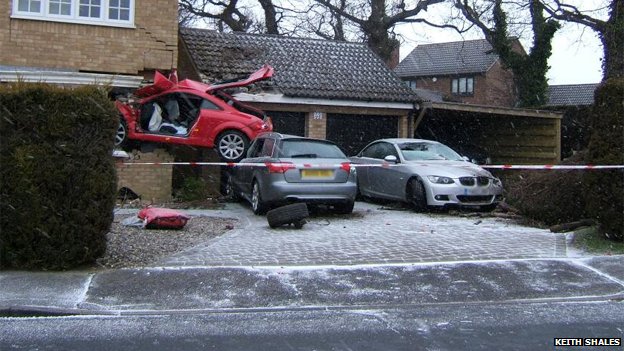
This car launched into the side of a house in the UK:

_66577137_66577136.jpg


Here's the story;

BBC News - Man seriously hurt as crash leaves car embedded in home

All I can say is wow!
 
Can you imagine this happening here in the States? Half of the house would be gone or the car would fly through it. Not a lot of houses here in the States are made from brick. Being from Europe myself it always made me wonder why brick isn't all that common here.

yeah over here nearly all houses are brick or (some older ones) stone. It always amazes me watching US programs where they build a house in a week, and how they can demolish an old one in a day :eek:
 
yeah over here nearly all houses are brick or (some older ones) stone. It always amazes me watching US programs where they build a house in a week, and how they can demolish an old one in a day :eek:

I guess I would wager that our collective history of world wars in our backyard, made us build stronger homes.


I wonder what propelled the car, could it be the curb?
 
I guess I would wager that our collective history of world wars in our backyard, made us build stronger homes.


I wonder what propelled the car, could it be the curb?

Hit the hedge..got abit of lift...hit the BMW....more lift and then finish with the AUDI...

Lift-off complete.

lol dumb ass.....or is it arse?!?!
 
I guess I would wager that our collective history of world wars in our backyard, made us build stronger homes.

North America is heavily forested to this day and the soil and climate are ideal for relatively fast-growing trees used in most construction.

Clay to make bricks is relatively rare compared to the UK and Europe in general.

The Romans built with granite, marble and other types of stone because their volcanic geography left them with quite a lot of those materials very close by. When they arrived in the British Isles, they found little in the way of appropriate stone readily available, but quite a bit of clay and clay sand from which bricks could easily be made. So they built Londinium and their other major cities mostly out of brick and most of the rest of the British Isles did the same.

Also, brick and stone are horrible materials for seismically active areas, which includes most of the populated sections of Western North America as well as some other regions here. Wood is good because it will flex in an earthquake rather than collapse. That's part of the reason traditional Japanese construction used wood.

Material availability and suitability for local conditions tends to determine what materials are used. We've got lots of huge forests, easily grown softwoods and seismic conditions that favor flexibility over absolute strength. So wood is appropriate.

 
North America is heavily forested to this day and the soil and climate are ideal for relatively fast-growing trees used in most construction.

Clay to make bricks is relatively rare compared to the UK and Europe in general.

The Romans built with granite, marble and other types of stone because their volcanic geography left them with quite a lot of those materials very close by. When they arrived in the British Isles, they found little in the way of appropriate stone readily available, but quite a bit of clay and clay sand from which bricks could easily be made. So they built Londinium and their other major cities mostly out of brick and most of the rest of the British Isles did the same.

Also, brick and stone are horrible materials for seismically active areas, which includes most of the populated sections of Western North America as well as some other regions here. Wood is good because it will flex in an earthquake rather than collapse. That's part of the reason traditional Japanese construction used wood.

Material availability and suitability for local conditions tends to determine what materials are used. We've got lots of huge forests, easily grown softwoods and seismic conditions that favor flexibility over absolute strength. So wood is appropriate.

That maybe the case for Western US, here on the Eastern coast, I think it's a matter of cost. newer construction is built here in NYC with either brick or stucco. I would also say that it might be a cultural issue. Americans are a lot more willing to relocate whereas in Europe houses tend to be passed down from generation to generation and there's more attachment to the family home.

We're pretty off topic haha. But it's good to learn something new everyday. I don't know that clay isn't that common here in the States.
 
Back
Top