

bmccrary
Touring Mod
Ok so I figured I would post this up since some of you guys, epically those of you that are serious into track days and suspension set ups could find this useful. Also, those of you who do a lot of touring 2-up or with significant luggage could find this useful.
So to save those who are lazy and just want to see numbers.... The 2005 FZ6's center of gravity is 29.83 inches back from the front axle and 19.393 inches up from the ground. This puts it just above the counter shaft sprocket. (Top of the cover..ish). This was with a full tank of gas and Givi Rack mounted to the rear. This is also with out a rider...
Now for those that care to learn how to do this or want to see where the numbers came from...read on.
To start off, I had to find these values in order to determine the mass moment of inertia for the motorcycle and compare it to the trailer that I am designing to be pulled behind the FZ for my senior design project. (More details on this later)
After talking to one of my car buddies the other night, he explained to me how to calculate the CG of a car so I went home and did some research and found an article on how to do this for a motorcycle, which is very similar to that of a car. But this article showed how to do this with a bathroom scale as apposed to a $5000 set of corner weight scales....
All Things Motorcycle - 106: Center of Gravity
I went to target and picked up a $8.00 analog scale (must be analog, digital will not allow you to read with weight on it starting out) Then I went to the hardware store and picked up an 8 foot piece of 2X8 and had it cut down to get two, 2 foot sections. Then I picked up a 1X1 and had it cut down into 1 foot sections. I then nailed the 1X1's to the bottom of the 2X8 sections at the ends.
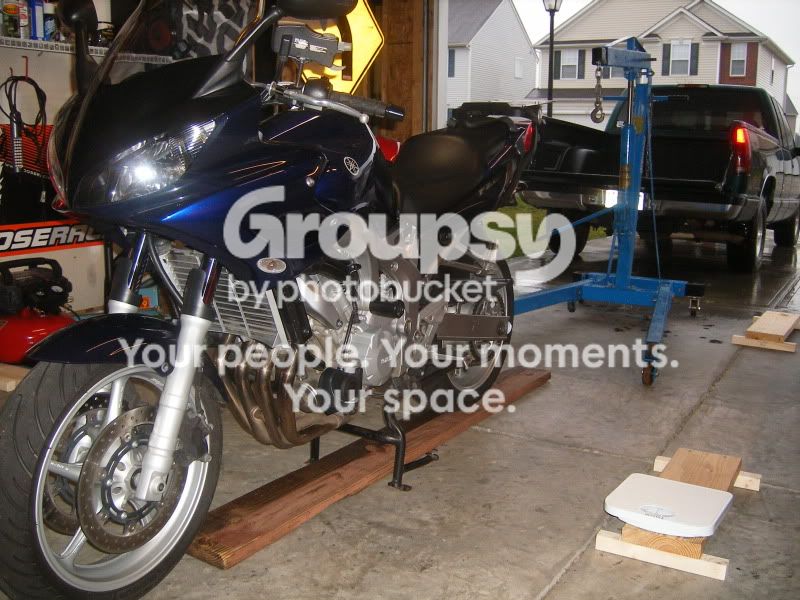
Placing my 2X8 motorcycle ramp board down (base board) first I then put the scale out front with one of my new platforms on top of the scale with the other end at the edge of my base board. Then I put the second platform towards the back of the baseboard for the rear wheel to rest on (bike must be level)
I measured both the front and rear wheel weight as the article states. For simplicity I made sure the contact patch was at 12inches so that I just multiplied the scale reading by 2.
That found the COM now to find the CG. I borrowed an engine hoist and jacked the back end of the FZ in the air about 12 inches above the front axle and took the weight reading from the front tire.
You can pretty much follow this guys directions and use his excel file to calculate this yourself.
Now here is the trick. Once the rider is on! Assuming that the normal human being's CG is roughly around their belly button... I weigh around 200lbs with gear on and once on the bike my belly button is about 40 inches from the ground. Summing the CG's from the bike and myself... the CG raises up to 25.64 inches off the ground.
Now I could go back later and weigh the front and rear of the bike with myself on it to determine what the weight percentage is front and rear. With out myself on it I got 224lbs on the front and 246lbs on the rear. Which came out to be ~ 48%/52% respectively. With rider on board this will shift further back. Now you can imagine it will continue to shift as luggage and a passenger is added. Thus the need to upgrade suspension components out back if a significant amount of your riding time is 2-up touring.



Just figured I would share this... hope it helps someone other than me. LOL.
-bryan
So to save those who are lazy and just want to see numbers.... The 2005 FZ6's center of gravity is 29.83 inches back from the front axle and 19.393 inches up from the ground. This puts it just above the counter shaft sprocket. (Top of the cover..ish). This was with a full tank of gas and Givi Rack mounted to the rear. This is also with out a rider...
Now for those that care to learn how to do this or want to see where the numbers came from...read on.
To start off, I had to find these values in order to determine the mass moment of inertia for the motorcycle and compare it to the trailer that I am designing to be pulled behind the FZ for my senior design project. (More details on this later)
After talking to one of my car buddies the other night, he explained to me how to calculate the CG of a car so I went home and did some research and found an article on how to do this for a motorcycle, which is very similar to that of a car. But this article showed how to do this with a bathroom scale as apposed to a $5000 set of corner weight scales....
All Things Motorcycle - 106: Center of Gravity
I went to target and picked up a $8.00 analog scale (must be analog, digital will not allow you to read with weight on it starting out) Then I went to the hardware store and picked up an 8 foot piece of 2X8 and had it cut down to get two, 2 foot sections. Then I picked up a 1X1 and had it cut down into 1 foot sections. I then nailed the 1X1's to the bottom of the 2X8 sections at the ends.
Placing my 2X8 motorcycle ramp board down (base board) first I then put the scale out front with one of my new platforms on top of the scale with the other end at the edge of my base board. Then I put the second platform towards the back of the baseboard for the rear wheel to rest on (bike must be level)
I measured both the front and rear wheel weight as the article states. For simplicity I made sure the contact patch was at 12inches so that I just multiplied the scale reading by 2.
That found the COM now to find the CG. I borrowed an engine hoist and jacked the back end of the FZ in the air about 12 inches above the front axle and took the weight reading from the front tire.
You can pretty much follow this guys directions and use his excel file to calculate this yourself.
Now here is the trick. Once the rider is on! Assuming that the normal human being's CG is roughly around their belly button... I weigh around 200lbs with gear on and once on the bike my belly button is about 40 inches from the ground. Summing the CG's from the bike and myself... the CG raises up to 25.64 inches off the ground.
Now I could go back later and weigh the front and rear of the bike with myself on it to determine what the weight percentage is front and rear. With out myself on it I got 224lbs on the front and 246lbs on the rear. Which came out to be ~ 48%/52% respectively. With rider on board this will shift further back. Now you can imagine it will continue to shift as luggage and a passenger is added. Thus the need to upgrade suspension components out back if a significant amount of your riding time is 2-up touring.
Just figured I would share this... hope it helps someone other than me. LOL.
-bryan


