Batteries, Charging & the Regulator Rectifier
Batteries, Charging & the Regulator Rectifier
************************** Link this thread:
Batteries, Charging & the Regulator Rectifier
Work in progress! Content will be changed/updated! I'm finding this one difficult, there is too much to cover so I'm trying to find a sensible way to organize it.
**************************
WARNING: Should your FZ6 need jump start, Do NOT jump it from a RUNNING VEHICLE as you can damaged the charging system. We'll go into details later, but remember that!
**************************
WHAT DO YOU NEED TO KNOW!
12 Volt Battery ~12.72V:
A fully charged 12 volt lead acid battery is ~12.72 volts! It needs at least 13++ Volts from the charging system to stay charged! Yamaha specified a "no-load output from the charging system of 14.1 - 14.9vdc. (( Each cell is ~2.12V X6 = 12.72 ))
HEALTHY BATTERY = something like this:
If you think your bike is having charging issues, get an inexpensive volt ohm meter. On a healthy system you should find something like this:
12.95V - Battery voltage, engine off for 30 minutes to 30 days
12.82V - 1300 RPM - fan off, may be higher with single headlight
14.30V - 2500 RPM - fan off, but less than 14.5V above 5000 RPM
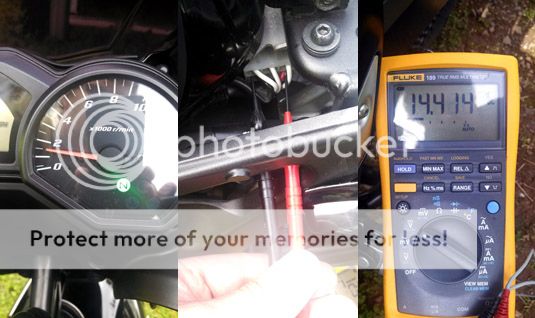
Battery Voltage can be checked from the RR w/the seat off:
Shown is Cold start, @ 1500 RPM, 14.4vdc
 DURING STARTUP - EXPECT something like this:
KEY ON = 12.00V +0.35V/-0.50V (not cranking)
CRANKING = 10.50V +0.25V/-0.50V i.e. start button depressed & cranking. It's normal for the battery to drop about ~1.5V from static no load to cranking. NOTE: Batteries are temperature sensitive. As their temps drops, so does the voltage. As their temp increases, so does their voltage.
ENGINE CRANKS SLOWLY or NOT AT ALL:
You must have a volt meter! NOTE: Values will vary from bike to bike these are approximations!
Place volt meter across battery terminals. Your charged battery should show >12.8Vdc. Turn on key, it should drop no more than ~0.75 Volts. Press the stater button, the battery voltage should drop no more than ~2.0V.
If your battery voltage drops 2 volts or more and the engine cranks slowly;
1) Your battery may need charged
2) Your battery may have lost its depth of charge and is unable to deliver current needed. Charge it for 3 hrs min.
If your bike makes a clicking sound, battery voltage while off shows 12.8 volts, but drops below 8 volts or more.
1) Attempt to charge battery but suspicion leads to #2 (replacement).
2) Battery has reached its life cycle. Replace it.
3) Can we bring back the dead??? See battery post below. Its a long drawn out drain and charge process.
*********************
- ERROR CODES DISPLAYED WHEN BATTERY VOLTAGE DROPS
- 46 Vehicle system power supply (Monitoring voltage)
- Power supply to the fuel injection system is not normal.
- Er-1 ECU internal malfunction (output signal error)
- No signals are received from the ECU.
Some members have reported the above errors as their battery was either low or failed to start their vehicle. Keep in mind that as the ECM does its diagnostic check, ER-1 may be displayed should the diagnostic check fail to complete. Think the ECM throwing up the white flag of surrender as its last communication before it could no longer function.
*********************
Caveats -
A bad starter will draw more current, crank the engine slower and drop more battery voltage! Jumping from a car battery may help, but if if it shows no real increase in engine cranking speed, check cables to starter, starter relay, and potentially -> replace the starter.
Bad connections, the engine will crank slower or not at all and the battery voltage drops a small amount ~1.0v or less. Check connections, it could be that your starter cannot get the energy from the battery to operate it!
What to check:
If the bike won't start or the lights are dim;
Is it the battery or the charging system?
With a hand held meter we can measure the system voltage looking for change between engine off, idle, and >2500 RPMs. It should maintain >12.65v or better on a good battery and increase (like the data above) when engine speed increases > 2500 RPMs. HOWEVER, its a system and if part of is damaged it can be more difficult to find the actual fault.
- Verify battery charge =>12.65 volts, if not, charge battery
- Verify voltage increases with engine running >2500 RPM. Expect about 13.75 to 14.50Vdc.
- Verify voltage does not exceed 14.9Vdc when RPMs increase to 7000 RPMs (note, just a quick blip to test).
- Verify there is NO AC voltage present. i.e. set meter to AC volts and measure output w/engine above 2500 RPM. Confirm @7000 RPM. Real world tests on an aged battery show ~1vAC at 5000 RPM.
Core components of the FZ6 Charging system:
XXXXXXXXXXXXXXXXXXXXXXXXXXXXXXXXXXX
UNDERSTANDING THE CHARGING SYSTEM:
The balancing act of Voltage vs Current!
The FZ has ~ 300 watts of energy that are available at 5000 RPM. From this we could measure the system voltage and get different values depending on the batteries health. For NOW, lets assume we have a working charging system and are just looking at system voltage. For example a fouled battery that WILL NOT TAKE A CHARGE could show a very high voltage OR a battery with a low charge could show a very low voltage because of the load imposed. That low battery will take more current to fill it up and this will drop the system voltage as we only have so much power to give. See table of 300 Watts!
REMEMBER: CURRENT or AMPS is what charges a battery not volts. HOWEVER, the voltage MUST BE ABOVE THE CELLS MINIMUM value (2.12V) to effectively convert that current (AMPS) into energy that charges the battery. So if the system is not getting close to the minimum 12.72v volts, its going to take longer to charge a low battery.
(( 300 WATTS; Voltage vs Current in AMPS )) Assume charing system is healthy!
300W / 12v = 25.0A << Battery charge is very low (*LOW*), all energy is converted to AMPS
300W / 13v = 23.1A
300W / 14v = 21.4A
300W / 15v = 20.0A << Battery is fully charged OR battery is sulfated and will not take a charge (* high*)
So, depending on the load on your system due to its current state, it may vary significantly depending on the battery state if charge. This factor makes it difficult to compare one system to another. Not to mention if part of the system is damaged.
(*LOW*) A healthy battery that is depleted, that wants to take a charge (it takes AMPS), will draw lots of amps, show a low charge voltage and possibly be a good battery once fully charged.
(*HIGH*) A sulfated battery could show a high system voltage when the bike is running but have NO DEPTH OF CHARGE. i.e. It may NOT start the bike or if left unused for too long go flat and be dead after a week. Yet as stated, it could look great when being charged because its showing a high voltage and NOT Drawing current from the system. **OR** a healthy fully charged battery may show a high system voltage as its doesn't need any current (Amps) to charge it. This is VERY MISLEADING!
Its misleading because MOST OF US can only measure ONE VARIABLE!!! We only have the ability to measure voltage and we need to know how much current is flowing. If we can measure BOTH, then we are in a position to see if the BATTERY OR THE CHARGING SYSTEM IS AT FAULT!
We know the three components; Watts, Voltage and Current. If we know two we can solve for the other one. There are ways to do this but it gets tricky. For the most part its easier to Fully Charge our battery and then LOAD TEST the battery (determine its heath) than it is to measure system current or Stator Output in Watts. Thus, a known Good Battery can point blame at the charging system.
XXXXXXXXXXXXXXXXXXXXXXXXXXXXXXXXXXX
Testing the Stator:
XXXXXXXXXXXXXXXXXXXXXXXXXXXXXXXXXXX
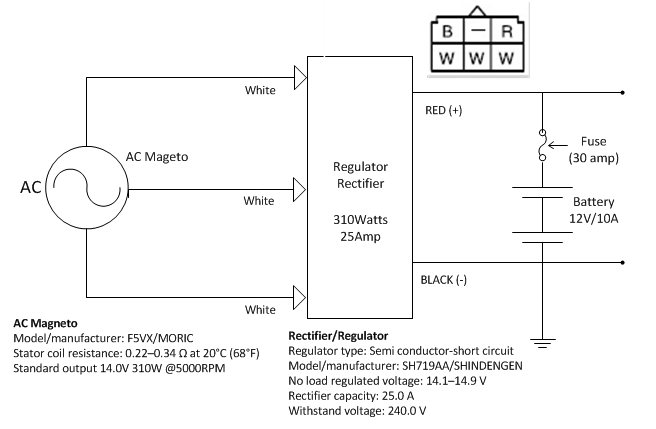
Stator coil resistance (Note: unplug Stator at RR
0.22–0.34 Ω at 20°C (68°F)
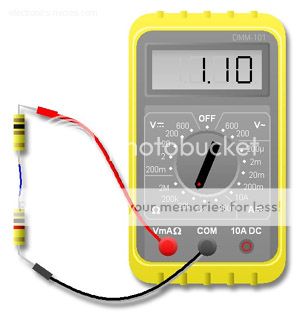
The only way to get an accurate reading is to use the Range of 1.0 Ω and short the meters leads together and Record this value so it can be subtracted from your final readings or if the meter has advanced functions, Zero the or press the "relative" button. This takes the current reading in ohms and subtracts the leads resistance so the meter is now reporting 0.000 ohms. Now test each of the three combinations of White wires to the stator.
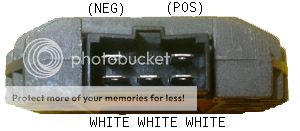
Check A, B, & C to verify 0.22–0.34 Ω
Check A -> B
Check A -> C
Check B -> C
Check A, B, & C to Engine ground. This should read infinite ohms (i.e. more than 1,000,000 Ω)
Example: If your meter is set to 1 ohm scale and it reads 0.39 ohms while the leads are firmly touching each other, subtract 0.39 ohms from ALL readings.
So if White A to white B = 0.67 ohms, subtract 0.39 = 0.28 ohms = PASS or tests good. If it reads 2.5 ohms, the Stator is bad. Or if testing lead C to the engine ground shows 20 ohms. The stator is bad and it needs replaced.
AC Voltage test. Sorry - Nothing Concrete here:
- If we all had a NEW fully charged battery and a single headlight and were to measure between the white leads at 1300, 2500, and 5000 RPM and we could compare our results. The problem is each situation is different is different and the load on the stator will vary. This will drastically impact test results!
STATOR OUTPUT ->> WILD GUESS Approximation:
If your stator is suspect you can test its AC output with it connected to the RR (it needs a load) and the engine running. The state of your battery will impact your readings as will the health of the RR and the amount and number of accessories used (example: incandescent vs HID lighting).
1300 RPM ~ 15 - 20vAC
2500 RPM ~ 40 - 50vAC
5000 RPM ~ 80 - 90vAC
Stator output measurements:
No load = higher output voltages. A bad (internally open) RR = higher output voltages.
A shorted diode in the RR could make the RR look bad as that would be a very high load.
This drawing is showing more detail as to what's inside the RR - a series of diodes that allow current flow in one direction but not the other.
A video - how to check the diodes in the RR
Title: Stock motorcycle regulator/rectifier check out. By: Roadstercycle
[ame="http://www.youtube.com/watch?v=F8EjV0IjW9Q"]YouTube[/ame]
XXXXXXXXXXXXXXXXXXXXXXXXXXXXXXXXXXX
Charging system basic:
**************************
In simple terms the battery is like a glass water we want to keep full and ready for use. Its OK to take some from it, but as a rule of thumb, we must have enough time to put back what we've taken out. So, if you take out too much and then park it, you can end up with an empty glass/dead battery.
Here is some data from a USD 2008 FZ6 with dual headlight mod and the original battery. Voltage as found was 12.90V after sitting for 3 months w/out a charger. Although the FSM specified the output from the system at 5000 RPM, real world measurements find this:
the charge cuts in at just over 1450 RPM @14.26V, but that's not full output!
1300 RPM - 12.82V fan off (after 10 min idle)
1300 RPM - 12.10V w/dual headlights (after 10 minutes of idle 210°F w/fan on)
2500 RPM - 14.30V fan off
2500 RPM - 14.25V fan on
Applying this to the bike we find the following. At idle the charging system maintains battery voltage until the load exceeds its output. In this case, when the bikes cooling fan came on. If for example you're stuck in traffic AND the engine needs cooled by the fan, the charging system cannot sustain enough output to keep from using some of the batteries capacity. As such, it can quickly be running from the batteries reserve capacity when the charging systems output falls below ~12.65V. For those of us on the highway at speed this is not an issue, but if stuck in traffic for too long and not able to run the engine above 2500 RPM, it can be an issue which results in a dead battery. In short, if you idle for 30 minutes you also need to ride above 2500 RPM for 30 minutes or reduce the load on the battery (unplug gear, lights, etc).
Additions like heated vests and dual headlights can be used but if you do lots of short trips, idling, (example could be day of BRC), you'll need to trickle charge at home or balance that idle time with run time above 2500 RPM's before parking the bike.
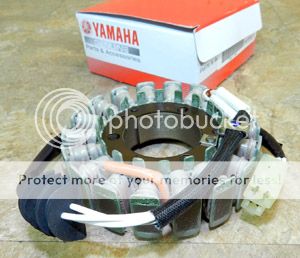
FZ6 Stator Assembly:
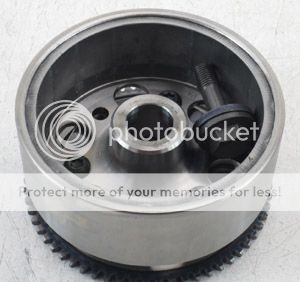
FZ6 Generator Rotor: A series of magnets inside...
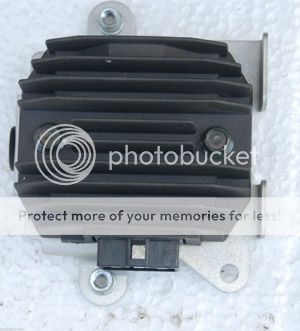
FZ6 Regulator Rectifier:
((BATTERY PICTURE i.e. use imagination :thumbup: ))
As you can see the basic charging system is not all that complex. On the bike it goes through several different wiring harnesses and connections but the basic system is straight forward. Something to note is the Regulator Rectifier (RR) is always connected to the battery. So if the RR goes bad in the wrong way, it can drain your battery!
**************************
Technical Details:
**************************
As the name implies the AC magneto produces Alternating Current (~90VAC++ @5000 RPM). This AC energy is converted to DC or Direct Current by the rectifier. Integral to the Rectifier is systems voltage regulator which maintains the output at safe levels for all of the bikes electric components ~14v. In addition there is a load or resistor inside the RR which is called a shunt resistor that consumes unused energy produced by the charging system if there is no need for it.
So we have the 12V 10A/hr rating battery, the AC magneto, and the Regulator Rectifier. As seen above, the AC magneto is two components. A spinning permanent magnet (spun by the engines crankshaft) and the stator core & wires. The RR is an electronic power converter capable of converting a wide range of AC power to regulated DC power.
Unlike a car, this system outputs its full potential all the time regardless of the bikes actual needs (the load or demand if you will). So even if the bike does not have a demand for 25 Amps of current, this system is producing ~ 25 amps once above ~2500 RPM. For all intensive purposes, its stupid and energy output is proportional generator rotor speed (crankshaft RPM).
As you can expect, depending on the need or demand, i.e. lights on, depth of battery charge, fan on/off, heated gear etc, sometimes the bikes USES ALL of the POTENTIAL OUTPUT and sometimes it doesn't. When it doesn't us all of the energy produced it must get rid of it. It does this by converting it into heat by means of dumping current into a resistive load in the RR. Hence the name "current shunt RR".
*** THIS IS WHERE WE TALK TO JUMP STARTING FROM ANOTHER VEHICLE*** Because the charging system is effectively "senseless" with regards to the bikes actual energy needs, any unused energy is dissipated into the shunt resistor internal to the RR. That's why it has cooling fins; to get rid of heat.
When jumping the FZ from an automotive charging system, that system sees the FZ's dead battery and its shunt regulator as a load taking energy from it. SO IT BEING SMART AND ADAPTIVE, IT APPLIES MORE ENERGY, MORE CURRENT to make its system OK! What it doesn't know it that too much current is a bad thing. It doesn't know its supposed to stop at 25 AMPS and it provides more! Lots MORE! A modern car is capable of 150+++ AMPS at 14.XX volts and this is where the RR on the bike gets cooked by having it connected to a running vehicle!!! DON'T DO IT!
What is confusing about the FZ charging system is this; full power at idle is basically battery voltage when the battery is fully charged - i.e. depending on the load imposed even though its outputting full potential all the time. This is because its potential is based on RPM not load. On the other end of the spectrum our engine at redline. Here the AC Magneto's output is upwards of 180vAC which is WAY TOO MUCH so we throw it away as heat into that shunt resistor!
Its more complex than this, but thats the basics. Its not efficient, but its simple and it works reliably in most cases.
I know that's a mouthful but thats the basics.
XXXXXXXXXXXXXXXXXXXXXXXXXXXXXXXXXXX
EDIT LIST:
2014-08-13 Added Video "Stock motorcycle regulator/rectifier check out" Thanks @
Motogiro
2014-05-27 added Er-1 ECU internal malfunction (output signal error
2014-05-04 added RED text, the balancing act 300 watts
2014-04-16 added typical battery voltages.
2014-04-14 added pictures of core components.
2014-04-20 TOSSED in some stator info - needs more details.
XXXXXXXXXXXXXXXXXXXXXXXXXXXXXXXXXXX